Fashion has always reflected the times we live in. Every generation has its own styles, its own trends and its own idea of what looks modern. Children’s clothing has never been immune to those changes. Over the years, colours have changed, fabrics have improved and designs have evolved. In many ways, that is exactly what fashion is supposed to do.
Yet beyond changing trends, something else appears to be changing, and it is a shift that many parents, grandparents and even young adults have quietly noticed without always knowing how to explain it.
Children are beginning to look older than they are.
Not older because they are maturing faster or behaving differently, but because childhood itself is increasingly being styled through the lens of adulthood. Clothes that once reflected comfort, playfulness and innocence are now, in many cases, inspired by adult fashion, where appearance, structure and presentation take centre stage.
On its own, that may not seem like a problem. Every parent enjoys seeing their child look smart, and there is nothing wrong with wanting children to dress neatly or stylishly. Beautiful children’s clothing has existed for generations, and taking pride in a child’s appearance has never been unusual.
The conversation, however, is not about whether children should dress well. It is about whether our idea of what “well dressed” looks like has gradually changed. More importantly, it asks whether that change says something about us as a society, rather than about children themselves.
The truth is that childhood has never simply been a stage of life. It has always carried its own identity. You could recognise it not only by age but by the freedom that came with it. Childhood was the season when scraped knees were more common than perfectly coordinated outfits, when clothes were expected to get dirty because children were expected to play. A dress was something to run in. Shoes were chosen because they could survive climbing, skipping and chasing friends across a playground. Looking presentable mattered, but it was never allowed to get in the way of being a child.
That balance feels different today.
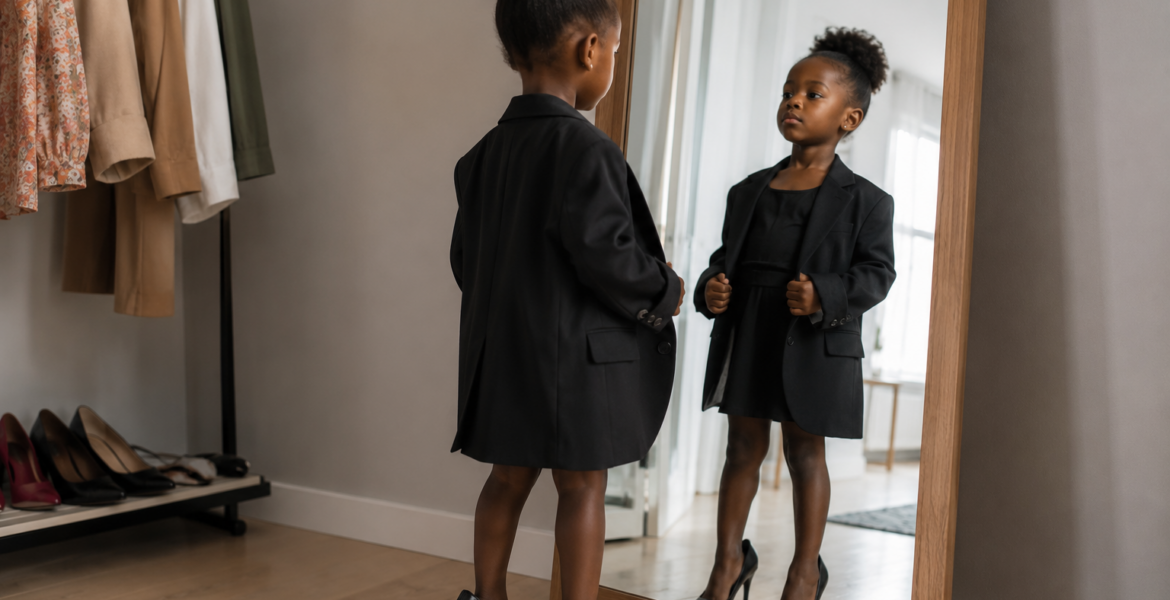
Walk into almost any children’s clothing store or spend a few minutes scrolling through social media and you begin to notice a pattern. Children’s fashion has become increasingly polished. Outfits are more tailored, accessories more sophisticated and styling more deliberate than many people remember from their own childhoods. Some collections are almost miniature versions of adult wardrobes, complete with handbags, blazers, heels and carefully coordinated looks that would not seem out of place on someone three times the child’s age.
None of this is being said to criticise parents. In fact, doing so would completely miss the point.
Most parents are simply making choices from the options available to them. They are responding to the same influences that shape the rest of society. Fashion retailers produce what consumers buy, social media amplifies what attracts attention and, before long, what once seemed unusual begins to feel completely normal. That is how cultural change often happens. It rarely announces itself. It arrives gradually, until one day we struggle to remember what came before it.
Perhaps that is why this subject has become so difficult to discuss. The moment anyone raises concerns, the conversation is often reduced to extremes. Some hear it as criticism of fashionable parents. Others see it as an attempt to reject modern trends altogether. In reality, neither interpretation captures the heart of the issue.
The question is much simpler than that.
What should childhood look like?
It is a question that sounds almost old-fashioned, yet it deserves serious thought because the answer influences far more than children’s wardrobes. It shapes the environment in which children discover who they are.
Clothing has always carried meaning. Adults understand this instinctively. We dress differently for a job interview than we do for a family get together because we know that what we wear communicates something about us. Clothing reflects identity, confidence, profession and personality. We do not think of it as merely fabric because it has never been merely fabric.
Children’s clothing has traditionally served a different purpose. It was designed around childhood itself. Comfort came before appearance. Practicality came before presentation. Freedom came before fashion.
That distinction matters because clothing quietly influences behaviour. Anyone who has ever worn formal clothes to an event knows they move differently than they would in sportswear. We become more conscious of ourselves. We sit differently. We walk differently. We avoid certain activities because we do not want to ruin what we are wearing.
Adults understand those trade-offs because adulthood is full of occasions that require them.
Childhood has always been different.
A child should be able to kneel on the floor without worrying about creases, race across a field without thinking about keeping shoes spotless and climb onto playground equipment without being reminded every few minutes to “be careful with your clothes”. Those moments may seem insignificant, but together they form the texture of childhood. They are the ordinary experiences through which confidence, curiosity and independence develop.
This is why the conversation is not really about fashion.
It is about what we are encouraging children to become aware of, and when.
A child who spends more time thinking about preserving an outfit than enjoying an afternoon outdoors is experiencing childhood differently from previous generations. Not necessarily because anyone intended that outcome, but because expectations have subtly shifted. Appearance begins to demand attention earlier than it once did, and when appearance becomes more important, self-consciousness often follows.
That does not happen overnight, nor does it happen because of one dress, one photograph or one pair of shoes. Culture rarely works through dramatic moments. It works through repetition. Small messages, repeated often enough, eventually become normal. Children absorb those messages with remarkable ease because they learn far more from the world around them than from the occasional lesson adults deliberately try to teach.
One compliment about looking “so grown up” means very little on its own.
Hundreds of similar messages over the course of childhood can mean something quite different.
Those messages do not always come from parents, nor are they always spoken aloud. More often, they are woven into the world children are growing up in. They appear in the advertisements they see, the children’s fashion campaigns they are featured in, the television programmes they watch and, increasingly, on the phones held by the adults around them. Long before children understand trends, they understand attention. They notice what receives compliments, what people stop scrolling to admire and what earns the most enthusiastic reactions. Children are exceptional observers. They are constantly learning what the world celebrates, even when nobody is deliberately trying to teach them.
That is one of the reasons this conversation is more complicated than simply discussing clothes. Fashion has become part of a much larger culture where appearance is documented, shared and evaluated more than at any other time in history. Family photographs, once taken to preserve memories, are now often shared instantly with hundreds of people. Birthdays become content. School concerts become Instagram stories. Even ordinary afternoons at the park can become carefully curated snapshots of family life. None of this is inherently wrong, but it has quietly changed the relationship many families have with appearance.
Parents are not immune to these pressures either.
Every generation has raised children according to the world they knew. Today’s parents happen to be raising children in a world where images travel further than conversations and where moments are increasingly experienced through a camera before they are experienced through memory. It would be unfair to pretend that this has no influence on the choices families make. When polished images are rewarded with admiration and engagement, it becomes easy to believe that every moment should look polished too.
Perhaps that is why childhood itself has become more carefully presented than it once was.
Children have always dressed up. Little girls have always enjoyed pretending to be princesses, and little boys have long imagined themselves as superheroes, firefighters or footballers. Imagination has always been one of childhood’s greatest joys. The difference is that dressing up was once part of play. It belonged to games, birthday parties and afternoons spent pretending to be someone else before happily returning to ordinary life.
Today, the line between dressing up and everyday dressing seems less clear.
Children are increasingly encouraged to look fashionable not only on special occasions but in everyday life. Retailers market seasonal trends specifically for toddlers. Beauty salons now offer services designed for children. Fashion shows feature collections that mirror adult wardrobes almost piece for piece. The industry has responded to demand, but demand has also been shaped by the culture surrounding it. Each influences the other until it becomes difficult to know where one begins and the other ends.
None of this means fashionable children’s clothing is inherently harmful. A beautifully dressed child is not automatically becoming self-conscious, just as a child wearing simple clothes is not guaranteed a carefree upbringing. Human development is far more complex than that. Personality, parenting, friendships, education and home life all play far greater roles in shaping confidence than any outfit ever could.
Acknowledging that, however, should not prevent us from asking whether clothing can still send subtle messages about what is expected of children.
After all, clothing has always reflected society’s expectations. We would never send a child to school wearing a wedding gown or football boots to a formal dinner because we instinctively understand that different clothes belong in different settings. In the same way, childhood itself deserves clothing that reflects its own unique stage of life. Not because children should be sheltered from beauty or fashion, but because every stage of life carries its own rhythm, and there is wisdom in allowing children to grow into each season rather than rushing them towards the next.
Perhaps the greatest gift childhood offers is freedom from constant self-awareness.
Adults spend much of their lives becoming conscious of themselves. We worry about first impressions, careers, appearances and the opinions of others. Many of us spend years learning how to silence those worries so we can simply enjoy life again. Childhood, by contrast, begins with an extraordinary freedom. Young children dance without embarrassment, laugh without restraint and ask questions without fear of looking foolish. They are wonderfully unconcerned with how they appear because they are fully occupied with discovering the world around them.
That freedom is fragile.
It gradually changes as children grow older, and that is perfectly natural. Teenagers become more aware of themselves. Young adults begin to think differently about appearance, identity and belonging. Growing up inevitably brings a greater awareness of how we are seen by others. The question is not whether that awareness will come; it always does. The real question is whether we are introducing it earlier than we need to.
It is worth asking because childhood is one of the few stages of life that cannot be revisited. Adulthood arrives for everyone, bringing with it responsibilities, expectations and pressures that cannot be postponed forever. Childhood, however, exists for only a short time. Once it passes, it does not return. That alone should make us cautious about anything that encourages children to leave it behind too quickly.
Perhaps that is why so many people feel a quiet sense of nostalgia when they see old family photographs. The clothes themselves are rarely remarkable. What stands out is something else entirely. Children looked comfortable. They looked unconcerned. They looked exactly like children.
Maybe that is what we miss. Not the fashion, but the freedom it represented.
More than a conversation about clothes
Perhaps the biggest mistake we could make is reducing this discussion to a debate about fashion. If we do that, we risk missing the much bigger question hiding beneath it.
The issue is not whether a little girl wears a designer dress or whether a little boy owns a miniature blazer. Clothing, on its own, is neither the problem nor the solution. It is simply one of the many ways culture reveals what it values.
Every generation leaves its fingerprints on childhood. Some generations valued discipline above all else. Others placed greater emphasis on education, independence or achievement. Our generation seems to value visibility. We document more, share more and pay closer attention to appearance than any generation before us. Inevitably, children are growing up within that culture, absorbing its values long before they are old enough to question them.
That is why this conversation deserves more thought than it often receives. The choices we make for children are never just about today. They shape the way children come to understand themselves and the world around them. When appearance begins to occupy more space in childhood, even unintentionally, it leaves less room for something else.
The question is: what are we willing to give up?
Are we comfortable exchanging carefree play for spotless outfits? Are we replacing carefree afternoons with carefully staged photographs? Are we celebrating children for who they are, or increasingly for how they appear?
These are not accusations. They are questions every parent, grandparent, teacher and caregiver can ask themselves, because all of us are raising children within the same culture. None of us stands outside it.
Perhaps that is why the answer is unlikely to be found in a wardrobe.
It begins with the way we choose to see childhood itself.
If we believe childhood is simply preparation for adulthood, then encouraging children to look, speak and behave a little older may seem perfectly natural. But if childhood has value in its own right—if it is a unique season of curiosity, imagination and freedom that deserves to be experienced fully—then preserving it becomes far more important than keeping up with changing trends.
Children have the rest of their lives to worry about fitting in, making good impressions and meeting society’s expectations. They will eventually become conscious of appearances, responsibilities and the opinions of others because growing up inevitably brings those realities with it. There is no prize for introducing those pressures earlier than necessary.
Perhaps that is why the simplest moments of childhood often become the ones we remember most.
Not the expensive outfits, not the carefully coordinated photographs, not the designer labels.
We remember muddy shoes after an afternoon in the rain. Ice cream stains on a favourite dress. School uniforms scribbled on by friends during the last week of term. We remember children laughing so hard they forgot who was watching, running so freely they forgot what they were wearing, and returning home tired, untidy and completely content.
Those memories stay with us because they capture something no trend ever can. They remind us what childhood feels like. And perhaps that is what this conversation has been about all along.
Not resisting fashion, not criticising parents, and certainly not longing for another generation.
BUT Simply asking whether, in our perfectly understandable desire to give children the very best, we might sometimes forget that the very best thing childhood offers cannot be bought, tailored or photographed.
It is the freedom to grow at its own pace. The freedom to be curious before becoming self-conscious. The freedom to discover the world before becoming overly concerned with how the world sees you.
That freedom is becoming increasingly rare, which is precisely why it deserves to be protected.
There is nothing incomplete about a child who looks like a child. There is nothing unfashionable about innocence, nothing outdated about simplicity and nothing old-fashioned about allowing children to enjoy every stage of growing up without asking them to skip ahead.
Perhaps the greatest gift we can give the next generation is not a more stylish childhood, but a slower one, a childhood with enough space for grass stains, untidy hair, loud laughter and all the wonderfully ordinary moments that children outgrow far too quickly on their own.
They do not need our help growing up. Time will take care of that.
Our responsibility is to make sure they have every chance to enjoy being children while they still can.