
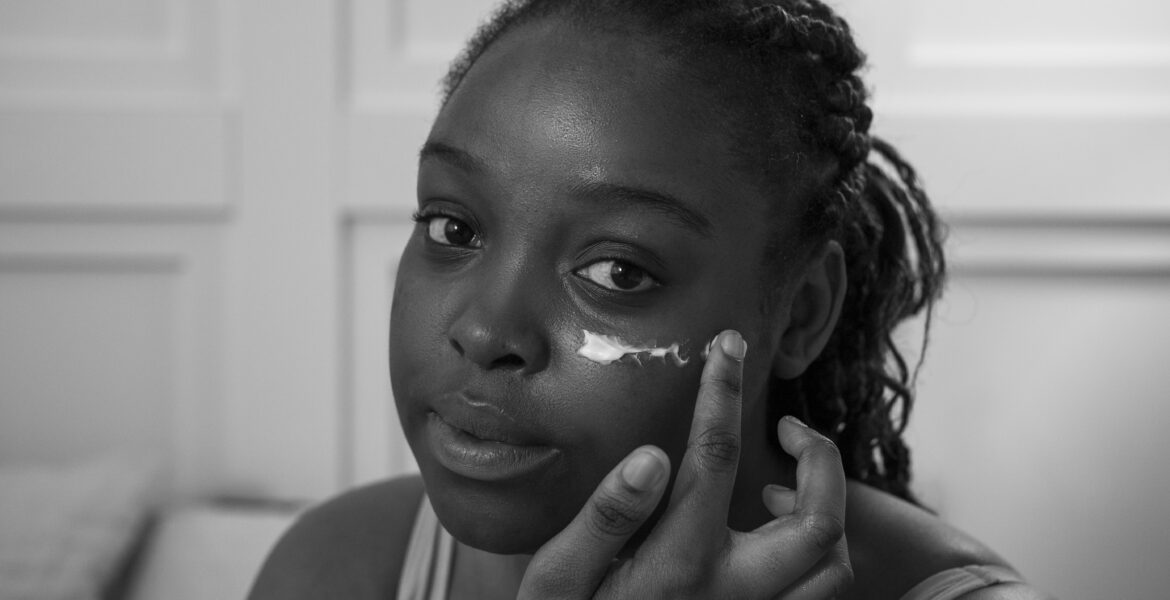
Recommend a skincare product and listen to the questions that follow. Will it make me fair? Will it brighten my skin? Is it good for dark skin? It happens so often that we barely notice how strange it is.
Even when the product is meant to treat dryness, acne, uneven tone or hyperpigmentation, the conversation often finds its way back to complexion, as though healthy skin and lighter skin are somehow the same thing.
That is worth thinking about, because dark skin is not dirty skin, damaged skin or unfinished skin. Yet in many homes, beauty spaces and everyday conversations, darker skin is still treated as though it is something that should be improved, softened, toned down or worked on.
When did “clean” begin to look like “light”?
You hear it in ordinary comments that people rarely stop to question. Someone gets darker after spending time outdoors and immediately hears, “You’re getting dark o.” A child is born and relatives begin to speculate about whether she will “become fair.” Someone starts using a new skincare product and, instead of asking whether their skin is healthier, smoother or less irritated, the first question is whether they have become lighter.
These comments can sound harmless because they are familiar, but repeated often enough, they create a message: lighter skin is something to celebrate, while darker skin is something to worry about.
That message has a name: colorism, which refers to prejudice or unequal treatment based on how light or dark a person’s skin is, often within the same racial or ethnic group. Research has documented how lighter skin can be privileged in ideas of beauty and desirability, particularly for women, while darker-skinned women may experience greater pressure to alter their appearance or feel less affirmed by prevailing beauty standards.
In one recent study exploring the experiences of Black and mixed Black-White adults, participants repeatedly described a beauty hierarchy in which lighter skin was often viewed as more desirable, while darker skin could attract less attention, fewer compliments or harsher judgments. That does not mean every lighter-skinned person has an easier life or every darker-skinned person has the same experience, but it does show that these ideas are not imagined. They are part of a much wider social pattern.
Sometimes we absorb colourism without realising it
One of the difficult things about colorism is that a person does not have to openly dislike dark skin to carry colorist beliefs. Sometimes those beliefs are inherited quietly through family comments, media, advertising, school, relationships and beauty culture.
You hear it when someone says, “I don’t want to bleach, I just want to be a little brighter,” or when a woman says she wants to “get her color back” because she remembers being lighter as a child. You hear it when a mother worries that her daughter is becoming “too dark,” or when people compliment one child’s fairness so often that another child cannot help but notice what receives the most admiration.
Most of these comments do not come from deliberate cruelty. Often, they come from years of learning that lighter skin attracts more praise, more approval and, in some settings, more social value.
Research on Black women’s beauty and body image has long described this connection between complexion and self-perception. Lighter skin has historically been associated with greater beauty and social advantage in many societies, while darker skin has often been treated less favorably. Over time, those messages can shape how women see themselves, even when nobody has ever directly told them that their skin is undesirable.
That is why the constant desire to “brighten” deserves a little more honesty. What exactly are we trying to brighten? If the concern is acne marks, uneven pigmentation, sun damage, dryness or dullness, those are valid skincare concerns. But if the real goal is simply to become lighter, then perhaps what needs attention is not the skin itself, but the belief behind the desire to change it.
The beauty industry did not invent colorism, but it has often benefited from it
 For years, beauty products have been sold using words such as whitening, fairness, lightening and brightening. Even when brands now use softer language, the underlying message can still be difficult to separate from the history behind it.
When someone grows up repeatedly seeing lighter skin presented as more beautiful, more refined or more desirable, wanting to move closer to that standard can begin to feel normal. The World Health Organization has acknowledged that harmful skin-lightening practices are driven by a combination of social norms, cultural pressures, beauty ideals and advertising. In 2026, WHO released a behavioral toolkit designed to help countries better understand why people use skin-lightening products and how those practices can be addressed.
There is also a serious health side to this conversation. Some skin-lightening products have contained harmful ingredients, including mercury compounds, and WHO has warned that exposure can damage the kidneys and nervous system while also causing skin problems.
That means the conversation is not simply about personal taste. In some cases, people are putting their health at risk in pursuit of a beauty standard they were taught to value.
Healthy skin does not have to be lighter skin
There is absolutely nothing wrong with wanting beautiful skin. Use sunscreen, moisturize, treat your acne, work on hyperpigmentation if it bothers you, find products that suit your skin type and see a dermatologist when necessary. Skincare can be enjoyable and empowering.
But perhaps the goal should be healthy skin rather than lighter skin.
A dark-skinned woman with clear, healthy, well-cared-for skin does not need to “work on her color.” A product has not failed simply because it did not make her fairer, and glowing skin does not have to mean skin that is several shades lighter than it naturally is.
There is a difference between improving the condition of your skin and trying to erase its natural complexion. The more honest we are about that difference, the healthier our relationship with beauty may become.
The way we speak around children matters too
Children notice much more than adults often realize. They hear who gets called beautiful, who gets told not to stay in the sun and whose complexion receives the most praise. They notice when one sibling’s fairness becomes a family talking point, and they absorb the jokes made about people who are “too dark.”
Imagine a little dark-skinned girl repeatedly hearing comments such as, “This one would have been so fine if she was fair,” or being told to avoid the sun because she will “get too black.” Nobody may ever sit her down and say that dark skin is ugly, but she can still learn which complexion seems to receive the most approval.
Years later, when she starts searching for products to lighten her skin, we may wonder where the insecurity came from. In reality, it may have been built quietly over years of listening.
Perhaps that is where change begins: not only with the products we buy, but with the words we use.
Instead of asking, “Will this cream make me fair?” we can ask whether it suits our skin type, whether it will help with acne marks, dryness or uneven tone, and whether it supports healthy skin. Instead of telling someone, “You’re getting dark,” perhaps we can simply let their complexion exist without commentary.
Dark skin is not a problem waiting for a solution. It is not less clean, less feminine, less beautiful or less worthy of admiration. And perhaps one of the most important things we can do, for ourselves and for the girls growing up around us, is to stop treating it as though it needs to be fixed.