
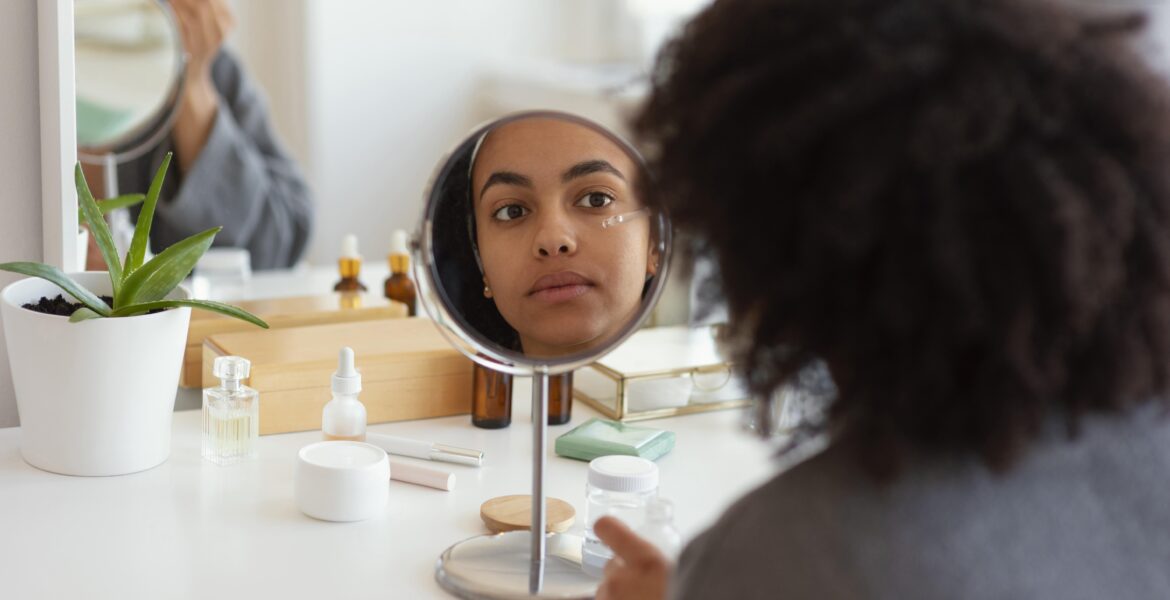
There has never been a more profitable time to make women feel that something is wrong with their skin.
Open almost any social media app and you’ll be surrounded by flawless complexions, poreless skin and promises that the right product can transform your face in a matter of days. Scroll for a few minutes and you’ll see glowing “before and after” photos, influencers recommending miracle creams and advertisements claiming that brighter, smoother skin is only a few applications away.
Without even realizing it, it’s easy to begin looking at your own reflection differently. A dark spot suddenly feels like a flaw that needs to disappear. Your natural complexion no longer seems bright enough. Fine lines that no one else has noticed begin to bother you. Instead of appreciating what your skin does for you every day, you start noticing only what you wish you could change.
Somewhere along the way, skincare stopped being about caring for the skin and became a constant search for perfection.
The problem with chasing perfection is that it keeps moving. The moment one concern disappears, another seems to take its place. First it’s acne, then it’s uneven skin tone. Then it’s texture, enlarged pores or signs of ageing. Before long, you’re buying product after product, hoping the next bottle, the next serum or the next viral skincare trend will finally give you the skin you’ve been promised.
But healthy skin doesn’t work that way.
One of the biggest mistakes many people make is believing that faster results are always better. We’ve become so used to instant gratification that waiting weeks—or even months—for skincare to work can feel frustrating. When a product promises visible changes in just three days or claims it can dramatically lighten the skin within a week, it’s understandable why people are tempted to believe it. After all, who wouldn’t want quicker results?
The reality, however, is that healthy skin rarely changes overnight. Your skin follows a natural renewal process that takes time. It repairs itself gradually, replacing old skin cells with new ones while constantly working to protect you from the environment around you. Products that truly support healthy skin work with this natural process, not against it. They improve your skin over time through consistent care, not shortcuts.
This is why products that promise instant transformation deserve a closer look. In many cases, particularly with unregulated skin-lightening products, those quick results may be achieved through ingredients that do far more harm than good. Some creams have been found to contain mercury, potent corticosteroids (commonly known as steroids) or dangerously high concentrations of hydroquinone. These ingredients can suppress the skin’s normal function, making it appear lighter or smoother in the short term, but prolonged or unsupervised use can leave the skin thinner, more fragile and far more sensitive than before. In severe cases, long-term exposure has been associated with permanent skin damage, uneven pigmentation, kidney problems and other serious health complications.
The difficult part is that the damage often doesn’t happen overnight. At first, the product may appear to be working exactly as promised. The skin may look brighter, blemishes may seem to fade and compliments from friends can make it feel like you’ve finally found the perfect solution. But weeks or months later, the skin may begin reacting differently. It becomes unusually sensitive. Dark patches return, sometimes worse than before. The skin barrier weakens, making it more vulnerable to irritation, infection and sun damage. What started as a journey towards clearer skin slowly becomes a struggle to repair damage that could have been avoided in the first place.
This is why prevention will always be more rewarding than cure.
Protecting your skin from unnecessary damage today is far easier than trying to repair years of damage tomorrow. Choosing products with safe, well-researched ingredients, wearing sunscreen every day, staying hydrated and resisting the temptation of harsh creams may not sound as exciting as a seven-day transformation, but these simple habits are the foundation of healthy skin. They don’t promise overnight miracles because healthy skin has never been built overnight. Instead, they quietly strengthen the skin, protect its natural barrier and allow it to thrive over time.
Your skin is a living organ, not a blank canvas waiting to be repainted. It changes with age, the weather, hormones, stress, pregnancy, diet and even the quality of your sleep. Expecting it to look exactly the same every single day is not only unrealistic, it’s unfair. The healthiest skin still has texture. It still has pores. It may have freckles, beauty marks or the occasional breakout. None of these things mean your skin is unhealthy—they simply mean it’s real.
Perhaps the biggest shift we need to make is moving from asking, “How can I change my skin?” to asking, “How can I take better care of it?”
Those are two very different questions, and they lead to very different choices. One encourages quick fixes. The other encourages patience, protection and consistency. One focuses on changing your appearance overnight. The other focuses on protecting your skin for the years ahead.
Beautiful skin has never been about looking like someone else. It’s about allowing your own skin to become the healthiest version of itself. When you stop chasing instant perfection and start investing in long-term care, something remarkable happens. Your confidence is no longer tied to the latest trending product or the next viral skincare routine. Instead, it grows from knowing that every choice you make is protecting, strengthening and respecting the skin you’re in.
That, perhaps, is the most beautiful skincare secret of all. The glow that lasts isn’t created by harsh ingredients, bleaching creams or impossible promises. It is built through patience, consistency and informed choices. Caring for your skin is not about winning a race to perfection; it’s about protecting something that will be with you for the rest of your life. And when you begin to see skincare that way, prevention is no longer just better than cure, it becomes the most beautiful investment you can make in yourself.